MDRC releases report about the New York City recidivism social impact bond

MDRC, the New York-based organization that designs and evaluates social programs, released a report about the New York City social impact bond program that was started in 2013. This social impact bond program is the first such program in the United States and one of only a handful social impact bonds that are in operation worldwide, with the others being in England and Australia. This program took several years to design; service provision started in January 2013 and continues to date. The report covers the design of the program, and questions such as whether the program has achieved its target results will be answered later once preliminary evidence becomes available.

Title: Financing Promising Evidence-based Programs: Early Lessons from the New York City Social Impact Bond

Date: December 2013

Authors:
Timothy Rudd, MDRC
Elisa Nicoletti, MDRC
Kristin Misner, NYC Mayor’s Office
Janae Bonsu, MDRC

Link: http://www.mdrc.org/sites/default/files/Financing_Promising_evidence-Based_Programs_FR.pdf

Job opportunities in social impact bonds

The world of social impact bonds / development impact bonds has been on a hiring spree over the past several months. Social Finance, Third Sector Capital Partners, my own firm Instiglio, and others have been hiring analysts, associates, and directors. Here are some of the listings:

Social Finance UK is hiring a development impact bond analyst.

Third Sector Capital Partners is hiring associates and directors.

Social Finance US is hiring an analyst and a director.

The Harvard Kennedy School Social Impact Bond Lab is hiring a senior technical advisor.

MaRS in Canada is hiring a social impact bond associate.

And, of course, my own firm Instiglio is looking for several positions as well.

Media coverage of social impact bond events in India

Image

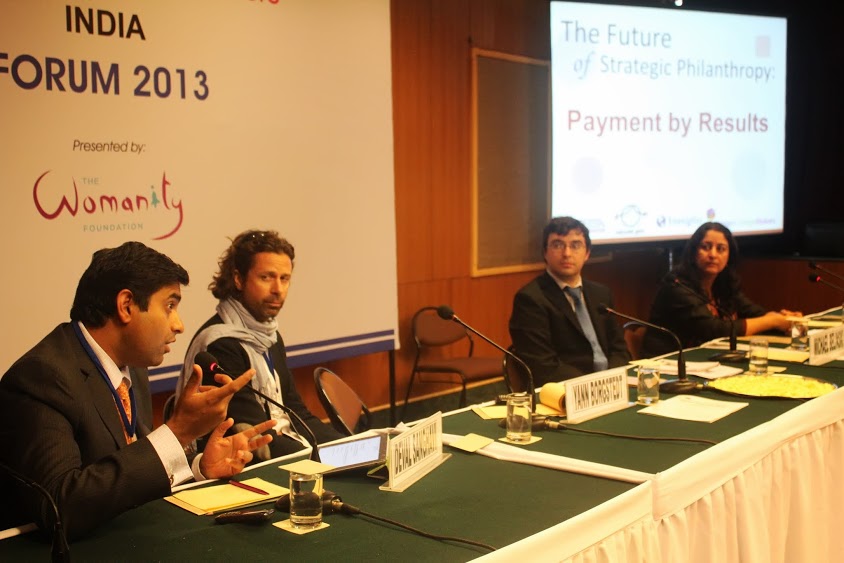
I returned from my three-week long trip to India recently, which has received some favorable coverage in the press. The Hindu covered our payment-by-results event in Bangalore, which was attended by approximately 50 people. The Economic Times of India covered our event in Mumbai, which was attended by about 70 people. Lots of this coverage will be recorded on Instiglio’s media mentions page.

I expected that overall demand for innovative ways to finance NGOs will increase in India as some of the multinational donors step back and re-evaluate their grant-making activity given tight budgetary environments. The challenge will be to find exceptionally good partnerships for demonstration projects of payment-by-results and social impact bonds.

Rockefeller Foundation and HKS SIB Lab announce 6 winners of social impact bond competition for technical assistance

This excerpt from the press release says it all:

Governor John Hickenlooper of Colorado: “Colorado is excited to be among this collective to strategically look at the role social impact bonds might play in solving some of our more complex social issues such as homeless and early childhood development.”

Governor Dannel Malloy of Connecticut: “Social impact bonds can potentially be an innovative way to help governments expand access to social services during challenging fiscal times. We are excited to be a part of the conversation, and look forward to working with partners in our state on next steps in the days and months ahead.”

Governor Pat Quinn of Illinois: “Illinois has successfully launched a social impact bond project which will help tackle major social problems and strengthen our communities. This innovative model is a unique way to invest in our community priorities without dipping into the pockets of our residents. I extend gratitude to The Rockefeller Foundation and the Harvard Kennedy School for recognizing Illinois as a pioneer in social innovation.”

Governor Andrew Cuomo of New York: “Social impact bonds provide an innovative way to encourage smart and cost-effective solutions to social problems. By attracting private investment to fund programming, this approach also ensures that solutions that work can be brought to scale. I am proud to have been an early advocate of this approach and look forward to our partnership with the SIB Technical Assistance Lab.”

Governor John Kasich of Ohio: “We’re constantly looking for new ways to innovate in order to provide better value for taxpayers, and the social impact bond model can help us do that. Not only does this approach help pursue solutions to tough problems, but it does so in an accountable, results-oriented way. The Rockefeller Foundation and Harvard’s Kennedy School have worked hard to fine tune and advance this unique public-private strategy and I’m excited about how we can use it in Ohio.”

Governor Nikki Haley of South Carolina: “South Carolina is excited to participate in the SIB Lab because we see public-private partnerships as the best way to bring innovative solutions to government. This is another reason for South Carolinians to celebrate as we move to the national forefront in creatively finding ways to improve maternal and child health.”

Making the Case for Intervention – A response

Alisa Helbitz and Emily Bolton from Social Finance UK reply to the Caroline Fiennes’s earlier Stanford Social Innovation Review article on the first social impact bond. They make a passionate defense of the Peterborough SIB in their article. They describe the benefits of the SIB, the challenges and the value of creating the first SIB, and note that the performance management system they created has shown promising results already.

One thing the article omits is the rationale for deciding on propensity score matching as the method for evaluation, and why, as they write, “[r]andomised controlled trials were not an option.” A discussion of this question is important for two reasons. The first reason is that several SIBs being designed elsewhere are attempting to use randomized controlled trials as the basis of evaluation. Therefore challenges encountered in Peterborough may have interesting lessons for persons designing these other SIBs.

The second reason is that a randomized controlled trial is valuable for an important reason. That reason is that the RCT reduces the likelihood that the outcomes we observe in the program happened by chance. Very often programs that appear to have delivered significant results among a set of individuals turn out to produce results similar to a comparison group of individuals that were not part of the program. The difference between RCTs and alternative measures has become so important that the U.S. government has started spending much more money on that evaluation method. So an understanding of when an RCT may be the appropriate tool for a SIB would be a useful addition to the ongoing conversation about this promising innovation.

NBER paper on social impact bonds

A rare academic paper has come out on social impact bonds. This one compares SIBs to alternative financing mechanisms. See abstract below.

“This note considers a relatively new form of financing for social services, the “Social Impact Bond.” Proponents of Social Impact Bonds argue that they present a solution to several problems in funding social services, including performance measurement and the distribution of risk. Using a simple model, we demonstrate that Social Impact Bonds have many features present in standard financing arrangements. They will lead to greater program success when investors’ effort can positively influence outcomes, but are unlikely to do so otherwise. We conclude that the value of this funding innovation will be strongly context-dependent.”

Pauly, Mark and Ashley Swanson. “Social Impact Bonds in Nonprofit Health Care: New Product or New Package?” NBER Working Paper 18991.

Named Echoing Green Finalist

In a bit of exciting news, I have been named an Echoing Green finalist, along with my co-founder and former classmate Avnish Gungadurdoss. The Echoing Green announcement is here and the Instiglio announcement is here. The three co-founders of Instiglio – myself, Avnish and Michael Eddy – decided to divide the work of applying to fellowships, as well as the benefits the fellowships bring; we have been successful in this strategy so far. Look soon for news from Michael Eddy.

Published in the San Francisco Fed

This week the Federal Reserve Bank of San Francisco published a 139-page issue of Community Development Investment Review devoted entirely to social impact bonds. I am one of five co-authors and members of the Harvard Kennedy School Social Impact Bond Technical Assistance Lab on an article describing lessons learned from implementation of social impact bonds in the United States. The Review is here and the article is here.

The full table of contents of the Review:

Foreword
Ian Galloway, Federal Reserve Bank of San Francisco

Background and Context

The Real Revolution of Pay for Success: Ending 40 Years of Stagnant Results for Communities
George Overholser and Caroline Whistler, Third Sector Capital Partners

Pay for Success is Not a Panacea
Daniel Stid, The Bridgespan Group

The Promise of Pay for Success
Jonathan Greenblatt, White House Office of Social Innovation and Civic Participation and Annie Donovan, White House Council on Environmental Quality

Social Impact Bonds: Lessons Learned So Far 
Hanna Azemati, Michael Belinsky, Ryan Gillette, Jeffrey Liebman, Alina Sellman, and Angela Wyse, John F. Kennedy School of Government, Harvard University

Pay for Success: Understanding the Risk Trade-offs 
Kristin Giantris and Bill Pinakiewicz, Nonprofit Finance Fund

The Ethics of Pay for Success 
Jodi Halpern and Douglas Jutte, University of California, Berkeley

Learning from the Low Income Housing Tax Credit: Building a New Social Investment Model 
Barry Zigas, Consumer Federation of America

Using Social Impact Bonds to Spur Innovation, Knowledge Building, and Accountability 
David Butler, Dan Bloom, and Timothy Rudd, MDRC

Roles and Responsibilities

Social Impact Bonds: Using Impact Investment to Expand Effective Social Programs
Luther Ragin, Jr., Global Impact Investing Network and Tracy Palandjian, Social Finance Inc.

Community Reinvestment Act (CRA) Banks as Pioneer Investors in Pay for Success Financing
Steven Godeke, Godeke Consulting

Innovation Needs Foundation Support: The Case of Social Impact Bonds
Kippy Joseph, Rockefeller Foundation

Pay for Success: Opportunities and Risks for Nonprofits
Laura Callanan and Jonathan Law, McKinsey & Co.

Success Begins with a Feasibility Study
Robert H. Dugger, ReadyNation

Government’s Role in Pay for Success
Kristina Costa, Center for American Progress and Sonal Shah, Case Foundation

Applications and Models

Rikers Island: The First Social Impact Bond in the United States 
John Olson and Andrea Phillips, Goldman Sachs

Human Capital Performance Bonds
Steve Rothschild, Invest in Outcomes

Pay for Success: Building On 25 Years of Experience with the Low Income Housing Tax Credit
Terri Ludwig, Enterprise Community Partners, Inc.

Can Pay for Success Reduce Asthma Emergencies and Reset a Broken Health Care System?
Rick Brush, Collective Health

Supporting At-Risk Youth: A Provider’s Perspective on Pay for Success
Lili Elkins, Roca Inc.

Tax Increment Finance: A Success-Driven Tool for Catalyzing Economic Development and Social Transformation
Toby Rittner, Council of Development Finance Agencies

Bringing Success to Scale: Pay for Success and Housing Homeless Individuals in Massachusetts
Joe Finn, Massachusetts Housing and Shelter Alliance and Jeff Hayward, United Way of Massachusetts Bay and Merrimack Valley

Making Pay for Success Work for Kids and Families
Patrick Lawler and Jessica Foster, Youth Villages